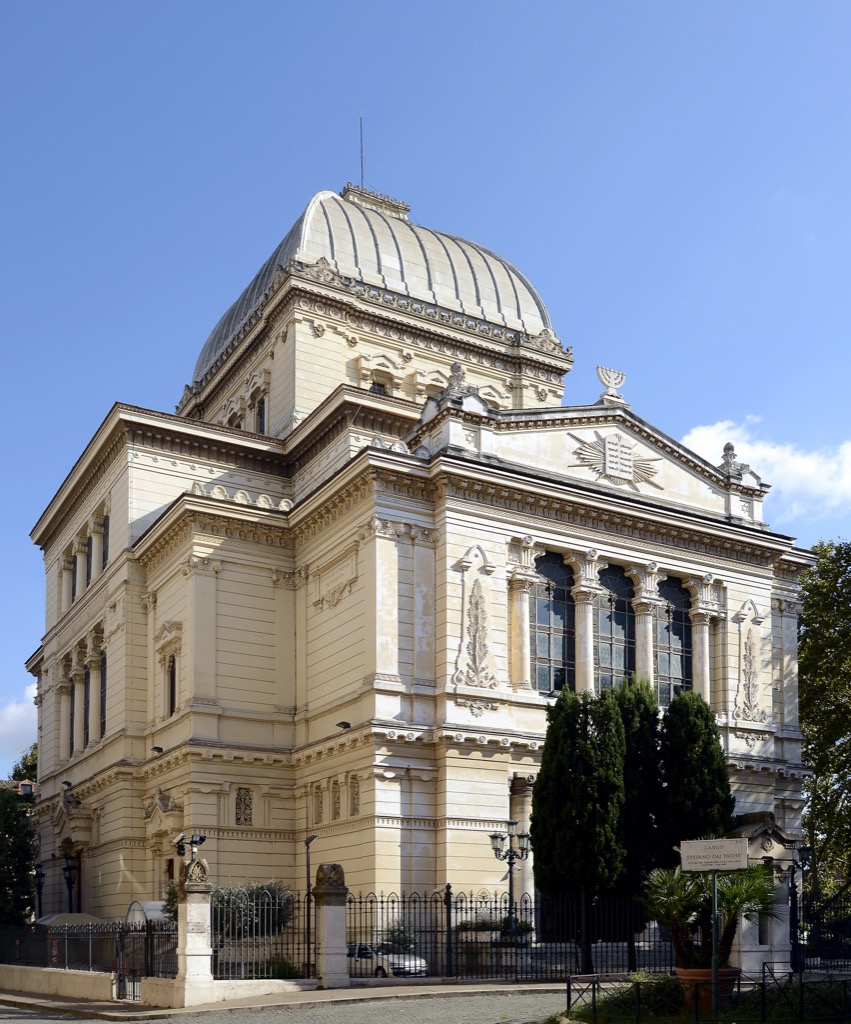
Welcome to a walk that reveals the true soul of Rome, a journey that weaves together two of its most evocative neighborhoods. This is not a tour of grand imperial monuments, but a story told on cobblestones, in hidden courtyards, and across a legendary river. We will explore a city of profound resilience and bohemian charm, discovering a history that is very much alive and breathing around you. Prepare to step away from the crowds and into the heart of Roman life.
Our journey begins in the vibrant chaos of Campo de' Fiori, a square that perfectly captures the city's dual nature. By day, it is a bustling, colorful market, but its history is etched in the solemn gaze of the statue of Giordano Bruno, a philosopher burned at the stake right here. It is a place of commerce and tragedy, of everyday life played out on a stage set for history. Feel the energy here, as it will be your starting point for a deeper dive into the city's past.
From the open square, we will wander into the narrow lanes of the Jewish Ghetto, one of the oldest in the world. This is a place of powerful stories, a testament to the endurance of a community that has shaped Roman culture for centuries. As you walk, you are treading through layers of history, where ancient Roman foundations meet Renaissance buildings and the aroma of traditional kosher baking fills the air.
Within this historic quarter, you'll find that time is not a straight line. You will encounter the staggering arches of the Theatre of Marcellus, an ancient Roman structure that looks like a miniature Colosseum, and the nearby Portico d’Ottavia. These classical ruins are not museum pieces behind a velvet rope; they are woven directly into the fabric of the neighborhood, a constant reminder of the many ages this small piece of land has witnessed.
Our path will then lead us to the tranquil Tiber Island, or Isola Tiberina, a boat shaped island that has been a place of healing since antiquity. Crossing the ancient Ponte Fabricio, you will feel a shift in the city’s rhythm. This island serves as a beautiful and peaceful bridge, both literally and figuratively, connecting the historical center with the very different world that waits for us on the other side.
Once across the river, you enter Trastevere, which literally means “across the Tiber.” The atmosphere changes instantly. The grand avenues give way to a labyrinth of ivy draped lanes, artisan workshops, and hidden trattorias. This is Rome at its most intimate and picturesque, a neighborhood that has long been a haven for artists, writers, and anyone seeking the city’s more authentic, village like charm.
The social and spiritual heart of this enchanting district is the Piazza di Santa Maria in Trastevere. Here, locals and travelers gather on the steps of the fountain in front of the glittering facade of the Basilica of Santa Maria, one of the oldest and most breathtaking churches in Rome. It is a perfect place to pause, soak in the atmosphere, and watch the daily life of Trastevere unfold.
This tour is best enjoyed at a leisurely pace, so plan for at least three to four hours to fully absorb its atmosphere. The walk is mostly flat, but be prepared for uneven cobblestones, so comfortable shoes are a must. A morning start allows you to experience the market at Campo de' Fiori, while a late afternoon walk will reward you with the golden light of sunset in Trastevere, just as the neighborhood comes alive for the evening.
As we conclude our journey, you will have experienced more than just a series of sights. You will have walked through a living narrative of struggle, faith, art, and daily life. You'll understand how Rome is not just a city of emperors and popes, but a rich and complex tapestry woven by the countless ordinary people who have called these streets home for millennia. Let's begin our walk into the real Rome.
Audio Preview
Introduction to Two Sides of the Tiber: A Roman Tapestry
Route Overview
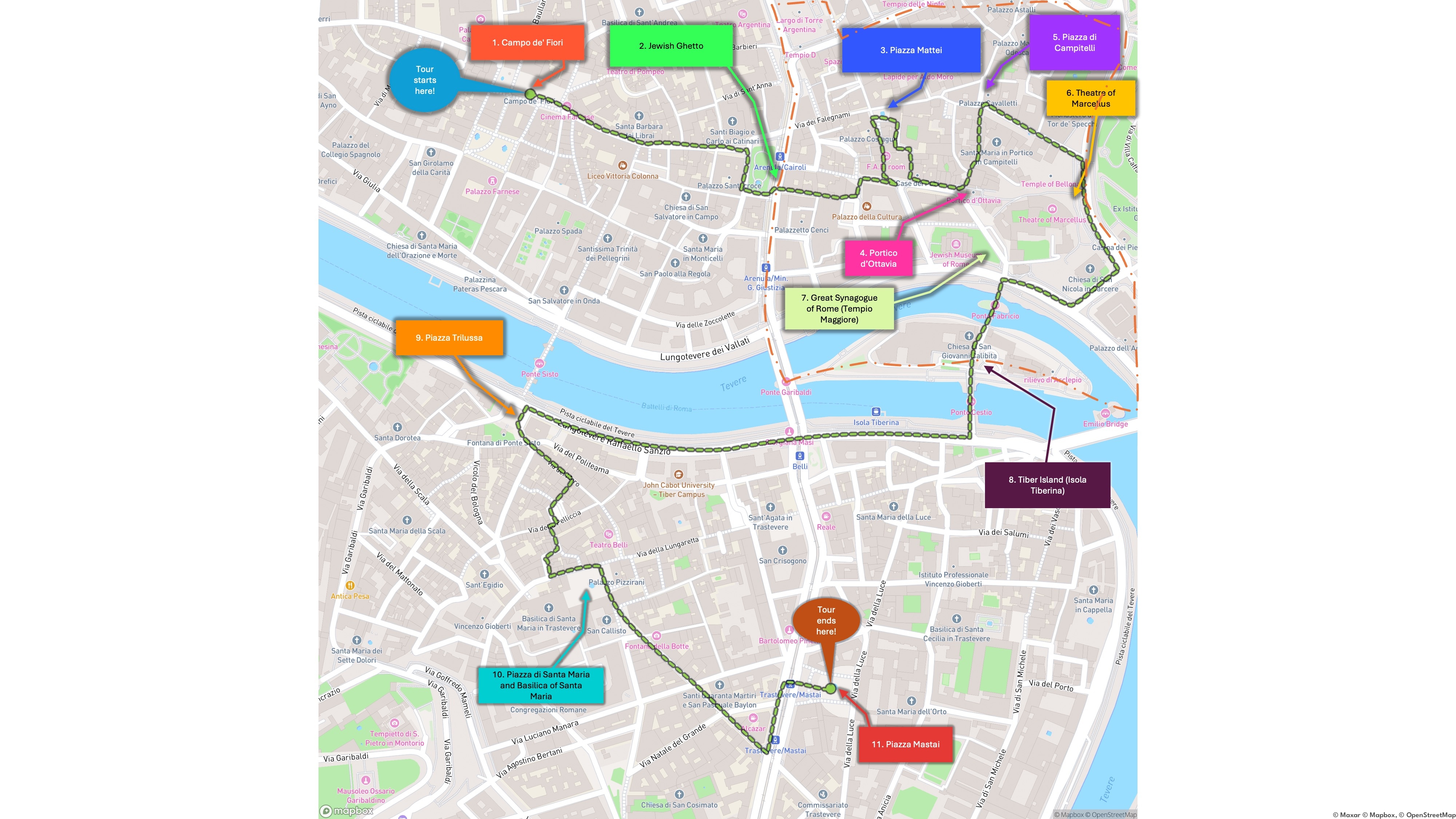
Stops on this Tour (11)
Campo de' Fiori
Welcome to **Campo de' Fiori**, the vibrant heart of **Rome**’s daily life, where we begin our **Jewish Ghetto and Trastevere** walking tour. As you stand in this bustling square, surrounded by the hum of vendors and the scent of fresh produce, you’re stepping into a place that’s been **Rome**’s marketplace for centuries. The name **Campo de' Fiori**, meaning “field of flowers,” hints at its medieval past when this was a meadow dotted with blooms. Today, the square pulses with energy, its colorful stalls offering everything from ripe tomatoes to fragrant herbs. To orient yourself, face the brooding statue at the center; this is **Giordano Bruno**, a philosopher we’ll meet soon. The photo shows the daily market with **Giordano Bruno**’s statue in the background, helping you spot this focal point. Feel the cobblestones underfoot; they’ve witnessed centuries of trade and drama. This square sets the stage for our journey through **Rome**’s layered history.
Jewish Ghetto
As we leave the wonderful chaos of **Campo de' Fiori**, let's continue our journey on the **Jewish Ghetto and Trastevere** tour. From the center of the piazza, please head east along the lively shopping street, Via dei Giubbonari, until you reach a small square called Piazza Benedetto Cairoli. We are now at the very edge of one of the most historically dense and moving neighborhoods in all of **Rome**: the **Jewish Ghetto**. Take a moment here; let the sounds of the city shift. You’re stepping into a place with a story of over two millennia, a narrative of both profound sorrow and incredible resilience that is etched into the very cobblestones beneath our feet.
Piazza Mattei (Fountain of the Turtles)
Welcome to **Piazza Mattei**, a small, tranquil clearing that feels like a reward after the narrow, history-laden streets of the **Jewish Ghetto**. I hope you enjoyed the short walk. As you step into this charming square, your attention is immediately captured by the masterpiece at its heart: the **Fontana delle Tartarughe**, or **Fountain of the Turtles**. Listen to the gentle sound of the water. It’s a moment of pure Renaissance grace and whimsy, a world away from the grand monuments of imperial **Rome**. This is one of the city's most beloved treasures.
Portico d’Ottavia
Hello again. Following the charming Via di Sant'Ambrogio, you've now emerged onto a street that shares its name with the monument before you: the **Portico d’Ottavia**. I hope you’re standing right in front of its grand, columned entrance. What we see today is a magnificent fragment, the gateway to what was once an enormous public complex. This isn't just a ruin; it's the front door to a lost world of ancient Roman culture, with a history far older than it first appears.
Piazza di Campitelli and Santa Rita da Cascia in Campitelli
As we leave the ancient grandeur of the Portico d'Ottavia, our short walk down Via della Tribuna di Campitelli has brought us into this stunningly beautiful square, the **Piazza di Campitelli**. Please take a moment. Notice the sudden sense of quiet and refined elegance. This is a perfect example of a Roman Baroque set piece, where the buildings and the open space are designed to work together in perfect harmony, creating a kind of outdoor theatrical stage. It feels secluded, a world away from the main tourist thoroughfares.
Theatre of Marcellus
I hope you’re now standing before the magnificent, curving facade of the **Theatre of Marcellus**. At first glance, it can be a little confusing. Many people mistake it for a smaller version of the Colosseum, but it is in fact much older. What you see is one of the most remarkable examples of historical layering in all of **Rome**: a monumental ancient theatre on the bottom and a grand Renaissance palace built directly on top. It’s not a ruin; it’s a living timeline made of stone.
Great Synagogue of Rome
You are now standing before a building that is unlike any other in **Rome**: the **Tempio Maggiore**, the Great Synagogue of **Rome**. Take a moment to look at its grand, monumental form and its unique, square-based dome rising against the sky. After centuries of being confined to the hidden courtyards of the Ghetto, this building, opened in 1904, was conceived as a powerful and visible statement. It is a symbol of emancipation, a proud declaration of the Jewish community's enduring presence in the heart of the city.
Tiber Island (Isola Tiberina)
You are now standing on the **Ponte Fabricio**, the oldest Roman bridge in the city that is still in continuous use, built all the way back in 62 BCE by **Lucius Fabricius**. As you cross, you arrive on a place that feels like a world unto itself: the **Tiber Island**, or *Isola Tiberina*. For over two millennia, this small, boat-shaped island has been a place of refuge and healing. Listen to the sound of the river flowing on both sides; you’ve stepped out of the city's chaos and into its ancient, sacred heart.
Piazza Trilussa
Welcome to the other side of the Tiber. As you walk from the bridge into this bustling square, you’ve officially arrived in **Trastevere**, one of **Rome**’s most enchanting and authentic neighborhoods. This is **Piazza Trilussa**, the grand, open-air foyer to the labyrinth of cobblestone streets behind it. Take a moment here. Feel the energy shift. You've left the monumental scale of the ancient city behind and stepped into a place with a fiercely independent spirit, a vibrant pulse, and a story all its own.
Piazza di Santa Maria and Basilica of Santa Maria
Welcome. After that delightful maze of alleyways, you’ve emerged into the light and space of the **Piazza di Santa Maria in Trastevere**. This is the true heart of the neighborhood, its grand, sun-drenched living room. Take a moment here by the central fountain. Feel the vibrant, yet relaxed atmosphere. This has been a gathering place for centuries, for locals, artists, and pilgrims alike, and it remains the social and spiritual core of Trastevere today.
Piazza Mastai
Hello again. Our walk has brought us out of the medieval maze and across the wide, modern Viale di Trastevere. Here, the neighborhood's character makes a sudden and fascinating shift. Welcome to **Piazza Mastai**, the final stop on our **Jewish Ghetto and Trastevere** tour. Take a look around. Notice the sense of order, the straight lines of the buildings, and the formal, planned feel of the space. It’s a world away from the charming, organic tangle of alleys we just explored.
Start this Journey
Download the Rome Audio Tour Guide Offline app to unlock the full audio guide, offline maps, and GPS navigation for this tour.