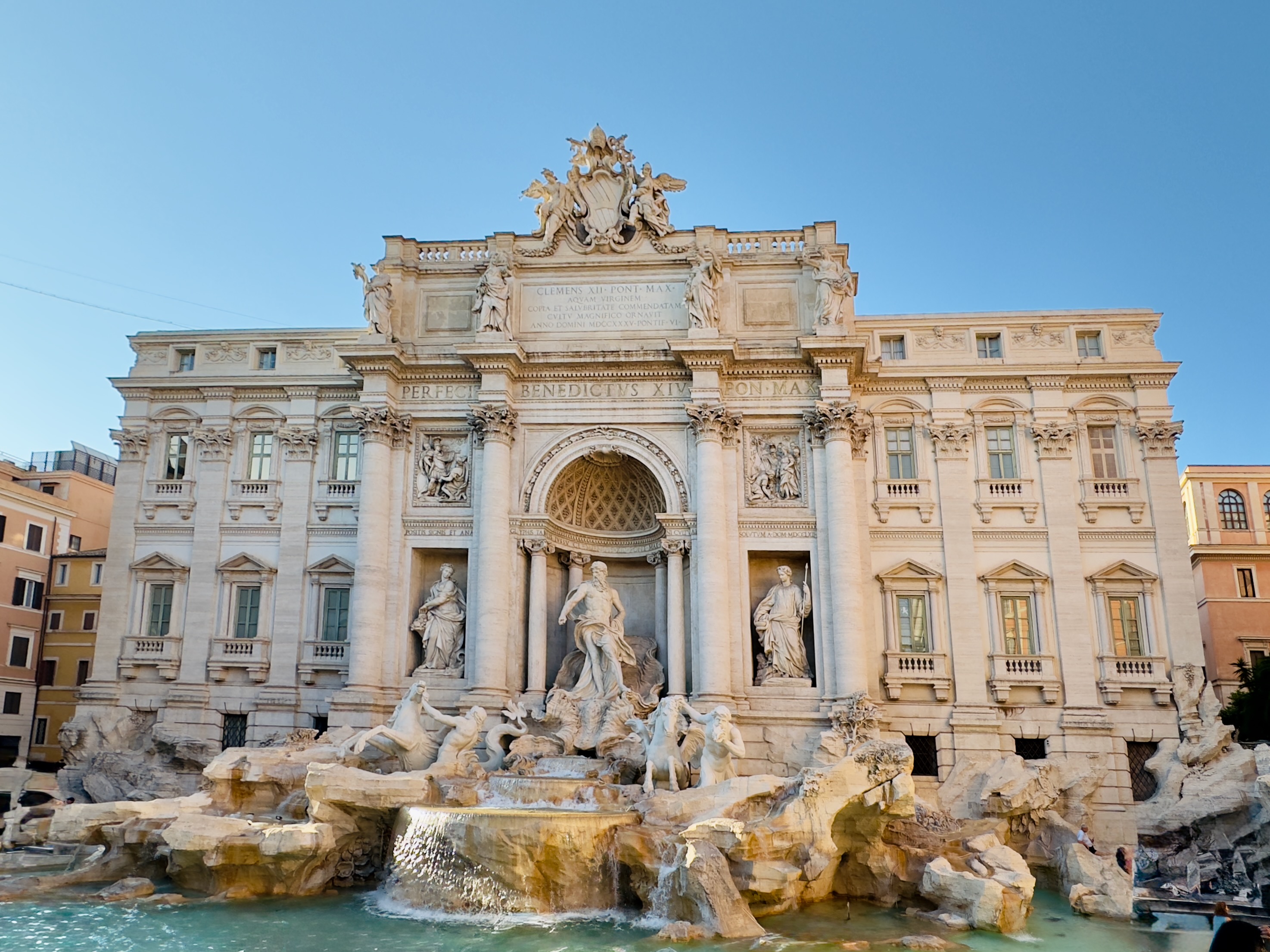
Before you even take your first step, pause and listen. Rome speaks. Not in shouts, but in whispers from its walls, fountains, and piazzas. This tour is your chance to follow the echo; from the thunder of imperial declarations to the soft rustle of handwritten letters in ancient courtyards. What awaits is not just a walk through beautiful streets, but a layered journey through centuries of ambition, belief, and everyday Roman life.
You’ll begin with a splash; quite literally; at the Trevi Fountain, where baroque drama meets ancient aqueducts. It’s more than just coins and wishes. It’s the heartbeat of the city’s enduring relationship with water, spectacle, and storytelling. Arrive early if you can; the morning light dances off the marble, and the crowds haven’t yet arrived with their gelato and tripods.
Winding through the city’s core, you’ll encounter power not just in palaces, but in symbolism. At Piazza Colonna, the towering Column of Marcus Aurelius still stands like a sentinel. Nearby, the Palazzo Montecitorio, now home to Italy’s parliament, reminds us that Rome never stopped being political; it just changed who held the microphone.
You’ll feel a shift as you enter Rome’s more cerebral heart. The Temple of Hadrian and the Church of Sant’Ignazio di Loyola are separated by a few paces but worlds apart in style and purpose. One celebrates imperial might; the other Jesuit contemplation. Between their columns and frescoed ceilings, you can sense how Rome has always negotiated faith and power.
Then comes a moment that feels like standing still in history. The Pantheon, with its vast oculus and perfect proportions, needs no introduction. But don’t rush it. Step back in Piazza della Rotonda; take a seat by the fountain; and let the geometry of ancient genius wash over you. Nearby, the quieter Piazza della Minerva and the curious elephant of Bernini offer a playful pause; Rome’s way of reminding us that wisdom and whimsy walk hand in hand.
You’ll stroll into smaller, more lived-in spaces like Piazza di Sant’Eustachio, where locals sip espresso in the shadow of old bell towers; and the Church of Sant’Ivo alla Sapienza, whose spiraled dome swirls like a thought just forming. These are not just stops; they’re clues to how Rome has always folded grandeur into daily life.
And then; Piazza Navona. A grand finale of fountains, sculpture, and performance. Built over an ancient stadium, it hums with energy. But even here, tucked nearby in a corner, is Pasquino, the so-called “talking statue” that once gave voice to Roman satire. As you listen to the sounds of modern chatter and street music, remember that this city has always talked back.
Your walk ends along Via del Governo Vecchio, where cobblestones remember every footstep and faded signs whisper of tailors, printers, and revolutionaries. Linger here. It’s not just the history that makes these streets special; it’s the way history refuses to leave.
Plan for at least two hours; more if you like to linger in churches or cafés. Most of the route is flat; though cobblestones can be uneven. Wear good shoes; bring water; and let your curiosity lead. This is a walk that rewards wanderers.
Audio Preview
Introduction to Roman Rhapsody
Route Overview
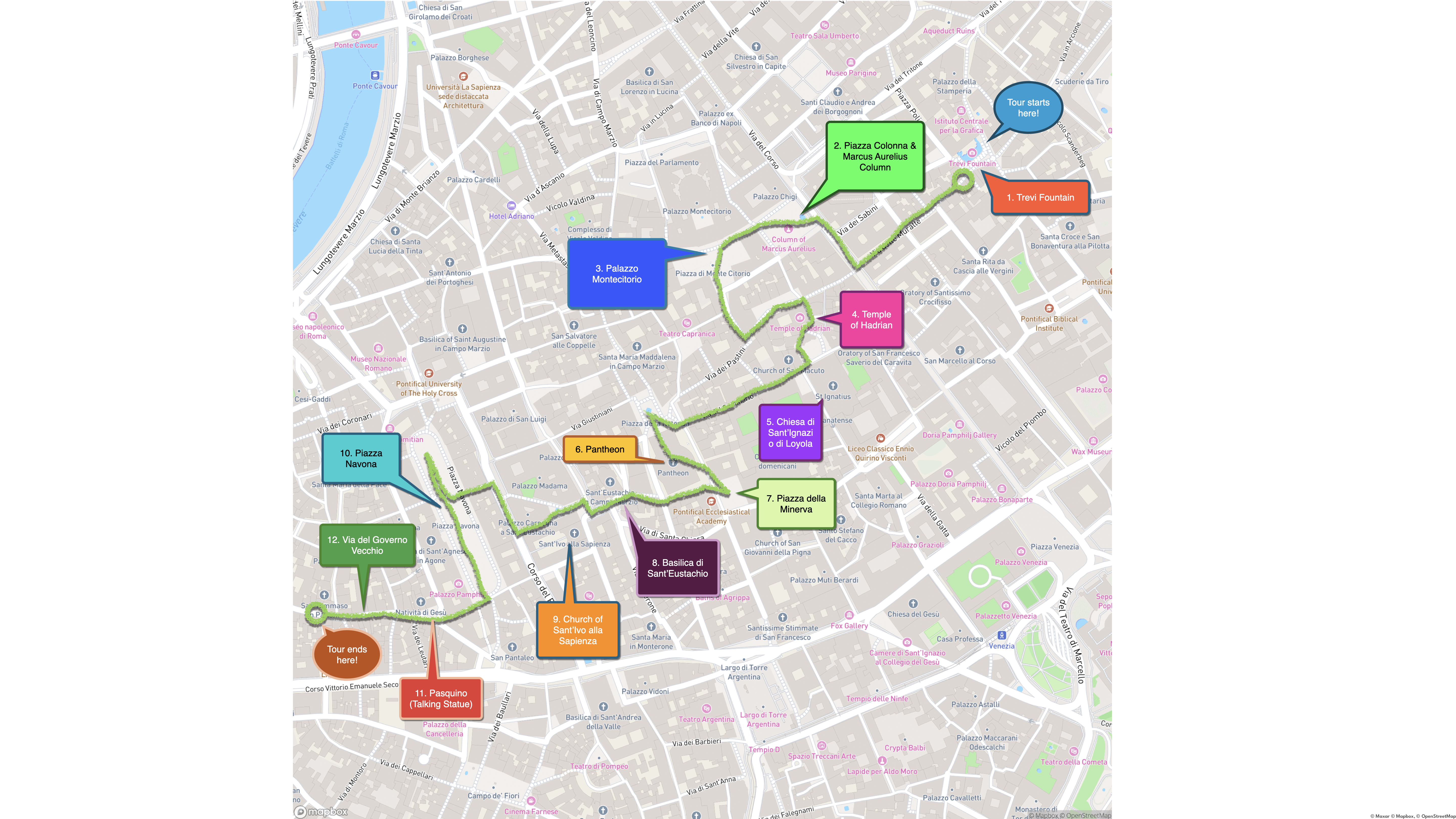
Stops on this Tour (12)
Trevi Fountain
Welcome to the **Trevi Fountain**, a radiant star in **Rome**’s constellation and the opening scene of our **Roman Rhapsody** tour. In the lively **Piazza di Trevi**, water cascades with a rhythmic roar, mingling with the hum of evening crowds. Designed by **Nicola Salvi** and completed in 1762, this Baroque marvel celebrates the **Acqua Vergine** aqueduct, flowing since 19 BCE. Its travertine façade, set against the **Palazzo Poli**, glows under over 100 LED lights after dusk, a modern touch from the 2015 restoration. Launched under the patronage of **Clement XII** in 1730, it transformed a water source into a cultural icon. To orient yourself, the photo shows the fountain’s sculptures shimmering in **Rome**’s light. Let’s explore this crossroads of history and artistry, where **Rome**’s pulse beats strong.
Piazza Colonna & Marcus Aurelius Column
As you leave the shimmering **Trevi Fountain** behind and stroll down **Via delle Muratte**, **Rome**’s lively energy envelops you with its charming shops and bustling cafés. You’ve arrived at **Piazza Colonna**, a vibrant stop on our **Roman Rhapsody** tour, where ancient ambition intertwines with modern vitality. At the square’s heart stands the **Column of Marcus Aurelius**, a towering Carrara marble monument celebrating 2nd-century Roman victories. To your right, the elegant **Galleria Alberto Sordi**, completed in 1922, frames the piazza with its graceful Art Nouveau arches. Nearby, **Palazzo Chigi**, home to Italy’s Prime Minister since 1961, pulses with political significance. The air hums with centuries of history, blending the clamor of today with echoes of an imperial past. To orient yourself, the photo shows the square’s lively expanse, with the column rising proudly at its core.
Palazzo Montecitorio
From **Piazza Colonna**, with the **Marcus Aurelius Column** soaring behind you, begin your journey on the **Roman Rhapsody** tour by heading west. Rome’s vibrant streets hum with scooters and voices as you approach **Piazza di Montecitorio**. Here, the grand neoclassical façade of **Palazzo Montecitorio**, home to Italy’s Chamber of Deputies, comes into view. Originally built as a judicial hub under the patronage of **Pope Innocent X** in 1653, this Baroque masterpiece now anchors Italy’s democratic heart. To orient yourself, look for the Egyptian obelisk rising at the piazza’s center; a photo captures its commanding presence. You’re standing where art, history, and governance converge in **Rome**.
Temple of Hadrian
Welcome to the **Temple of Hadrian** in **Rome**, a striking highlight of our **Roman Rhapsody** tour. Having arrived from **Palazzo Montecitorio** along the charming **Via dei Pastini**, you now stand in **Piazza di Pietra**, where ancient columns rise like guardians of history. Dedicated in 145 AD by **Antoninus Pius** to honor the deified **Emperor Hadrian**, these 11 Corinthian pillars anchor a site where Rome’s imperial past meets its lively present. Cafés hum with conversation, their energy mingling with the square’s cobbled serenity. To orient yourself, look to the north side of the piazza, where the columns blend into a Baroque facade, now the Rome Chamber of Commerce. If you have the photo, it captures the colonnade’s majesty against the piazza’s stones. You’re standing in a place where an emperor’s legacy endures, ready to explore its timeless story.
Chiesa di Sant’Ignazio di Loyola
As you step from **Via del Burrò**, leaving the ancient columns of the **Temple of Hadrian** behind, **Piazza Sant’Ignazio** opens before you in **Rome**’s theatrical heart. The **Chiesa di Sant’Ignazio di Loyola**, a Baroque jewel built between 1626 and 1650 for the Jesuit order, commands the scene. Consecrated in 1722, with final decorative touches continuing into the mid-18th century, it honors the Jesuit founder, a pivotal figure in the 16th-century Counter-Reformation. Its curving facade, crafted by **Orazio Grassi**, dominates the oval piazza, a stage set by **Filippo Raguzzini** in 1727. The square’s pastel Rococo buildings enhance the church’s grandeur, inviting you into a world of art and history. To orient yourself, the provided photo captures the facade’s dramatic curves, a signature of Baroque flair. This stop on our **Roman Rhapsody** tour unveils a blend of innovation and spectacle.
Pantheon
Welcome to the **Pantheon**, a timeless marvel in the heart of **Rome** on our **Roman Rhapsody** tour. As you step into **Piazza della Rotonda** from **Via del Seminario**, leaving the quiet charm of **Chiesa di Sant’Ignazio di Loyola** behind, the **Pantheon**’s massive columns rise before you. Built around 125 AD by **Emperor Hadrian**, this architectural masterpiece replaced an earlier temple by **Marcus Agrippa**, destroyed by fire. Its survival owes much to its transformation into **Santa Maria ad Martyres** in 609 AD, a pivotal moment that preserved its ancient grandeur. The cobblestones beneath your feet, smoothed by centuries of travelers, hum with history; the **Fontana del Pantheon** sparkles nearby, catching the Roman light. To orient yourself, the photo provided captures the piazza’s sweep, with the **Pantheon**’s facade and fountain in view. Stand here and take in the scene; you’re at the crossroads of **Rome**’s eternal story.
Piazza della Minerva
Welcome to **Piazza della Minerva**, a captivating stop on our **Roman Rhapsody** tour through **Rome**. From **Piazza della Rotonda**, you’ve strolled 100 meters down **Via della Minerva**, leaving the **Pantheon**’s grand dome behind. This intimate square hums with history; its cobblestones crunch underfoot, and the whimsical **Pulcino della Minerva**, a petite elephant balancing an ancient obelisk, greets you with charm. To your left rises **Santa Maria sopra Minerva**, **Rome**’s only Gothic church, its facade a subtle marvel. Medieval Romans named this square for a supposed **Temple of Minerva**, mistakenly identifying ruins of a **Temple of Isis** beneath the church. To orient yourself, the photo provided captures the square opening toward the **Pantheon**. Pause here; let the scholarly calm of this nook envelop you.
Basilica di Sant’Eustachio
As you arrive in **Piazza di Sant’Eustachio**, a lively hub of our **Roman Rhapsody** tour in **Rome**, feel the energy of the **Rione Otto** district’s cobblestone heart, just a three-minute walk north from **Piazza della Minerva** along **Via degli Staderari**. The **Basilica di Sant’Eustachio** anchors this intimate square, its early 18th-century **Baroque** facade crowned by a sculpted deer head with a cross between its antlers, a nod to a 2nd-century legend tied to the Roman general **Eustace**. The aroma of espresso from **Caffè Sant’Eustachio**, a beloved institution since 1938, mingles with the chatter of locals and scooters zipping by. This piazza, nestled near **Piazza Navona**, blends Rome’s layered history with the rhythm of daily life. To orient yourself, the provided photo captures the basilica’s glowing facade against the square’s bustling charm. Stand here and soak in the scene; it’s where Rome’s past and present dance together.
Church of Sant’Ivo alla Sapienza
Step into the **cortile** of **Palazzo della Sapienza**, a tranquil highlight of our **Roman Rhapsody** tour, reached after a four-minute walk southwest from **Piazza di Sant’Eustachio** along **Corso del Rinascimento**. The **Church of Sant’Ivo alla Sapienza**, a **Baroque** masterpiece by **Francesco Borromini**, commands attention with its spiraling **lantern** rising against the Roman sky. Constructed between 1642 and 1660 for **Sapienza University**, this church served the academic community, hosting ceremonies and lectures. The **cortile**, framed by the **Palazzo**’s arches, welcomes visitors when gates permit, though the church opens only for special events or select Sundays. If you need help orienting, the photo provided captures the **cortile**’s serene embrace, highlighting **Sant’Ivo**’s facade. The air carries a scholarly calm, distinct from Rome’s vibrant bustle. Pause and absorb the quiet elegance; this is where intellect and architecture converge.
Piazza Navona
Stroll into **Piazza Navona**, the dazzling star of our **Roman Rhapsody** tour; you’ve walked three minutes from **Sant’Ivo alla Sapienza** down **Via di Santa Giovanna d’Arco**, where cobblestones clatter and cafe chatter swells. This **Baroque** plaza, Rome’s liveliest stage, bursts with energy; fountains gurgle; artists hawk sketches; gelato vendors tempt with pistachio swirls. Built over **Domitian**’s ancient stadium, it’s framed by **Bernini**’s **Fontana dei Quattro Fiumi** in the center. To see the magic, the photo above captures **Quattro Fiumi**’s splash. Pause here; let the piazza’s pulse sweep you away.
Pasquino (Talking Statue)
Leave **Piazza Navona**’s vibrant hum and head toward **Pasquino**, Rome’s wittiest rebel, on our **Roman Rhapsody** tour; walk south toward **Fontana del Moro**, pass its playful splash, and turn right at the piazza’s end onto **Via di Pasquino**. Stroll just 30 meters down this cobblestone alley, where scooters zip and espresso scents drift from trattorias, to find **Pasquino** in a small square in **Rione Parione**. This battered statue, bristling with satirical notes, has mocked the mighty for centuries. Pause in front; let its defiant whisper draw you in.
Via del Governo Vecchio
Step away from **Pasquino**’s sharp quips and into the bohemian glow of **Via del Governo Vecchio**, the final stop on our **Roman Rhapsody** tour; walk west down **Via di Pasquino**, which merges seamlessly into **Via del Governo Vecchio** in a one-minute stroll through **Rione Parione**. This narrow street, alive with ochre facades, hums with vintage shops and late-night bars; scooters hum; pasta aromas waft. Stretching toward **Piazza dell’Orologio**, it’s Rome’s eclectic heart. To feel its pulse, the photo above captures **Via del Governo Vecchio** near **Ponte**. Pause here; let the street’s charm wrap around you.
Start this Journey
Download the Rome Audio Tour Guide Offline app to unlock the full audio guide, offline maps, and GPS navigation for this tour.