Roman Forum
Colosseum, Temple of Saturn, Arch of Titus, Curia, Temple of Vesta, Via Sacra, and More!
Welcome to a walk through the Roman Forum, once the heart of the known world. Here, history resonates with every step. This isn't just ruins; it's the stage of Roman civilization, from myth to imperial power. Prepare for the centuries to peel away.
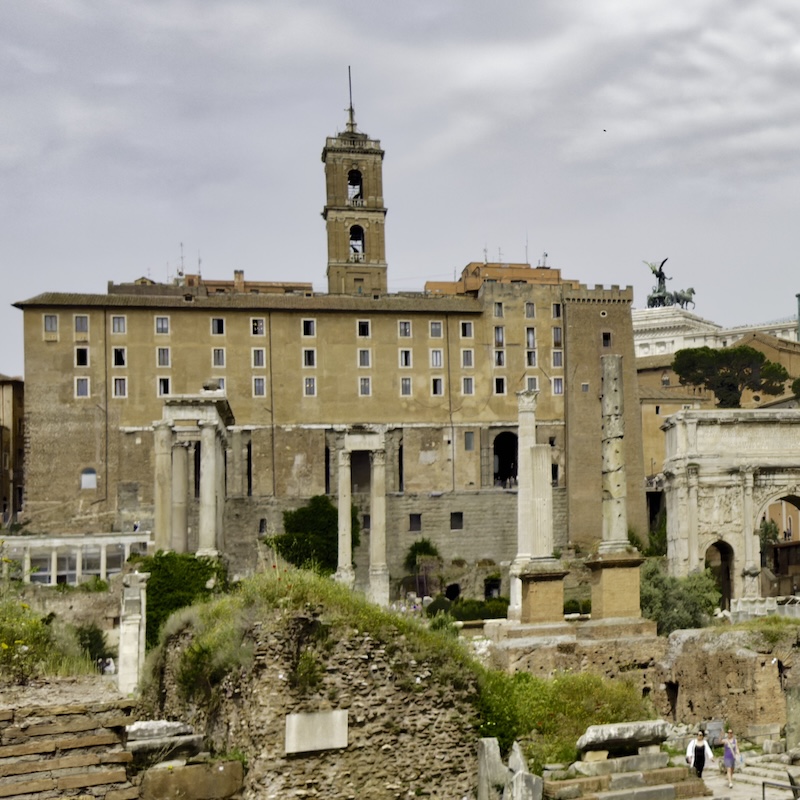
Our journey starts with a panorama from Via di San Pietro in Carcere, on the Capitoline Hill. Find this viewpoint by the stairs between the Mamertine Prison and the Temple of Concord and Tabularium. For directions, click the coordination icon at the top of each page in your guide.
Imagine this valley alive: senators debating, merchants selling, generals parading, and citizens gathering. This was Rome's civic, religious, and commercial heart, filled with sacred temples, bustling basilicas, and monuments, each telling an epic story.
Descending, the Tabularium, Rome's state archives, frames our view. Soon, you'll encounter the Arch of Septimius Severus, marking imperial triumphs, near the Rostra, the Umbilicus Urbis Romae, and the Milliarium Aureum, where all roads began.
The Forum's spiritual side is clear at the Temple of Saturn, an ancient sanctuary and treasury. Nearby, the Basilica Julia speaks of law courts, and the Temple of Castor and Pollux recalls city protectors. The Column of Phocas is a later, poignant marker.
We tread sacred ground. You’ll find the Temple of Caesar, or Temple of Divus Iulius, marking Julius Caesar's cremation. Nearby lies the mysterious Lapis Niger, an archaic shrine whose meaning was lost even to ancient Romans.
Roman governance becomes clear at the restored Curia Julia, the Senate House, and the Basilica Aemilia, a former public hall. The Temple of Antoninus and Faustina stands as an emperor's touching tribute to his wife.
Glimpse Roman religion's sacred heart at the Regia, ancient royal residence and office of the Pontifex Maximus. Nearby, the Temple of Vesta housed the eternal flame, tended by priestesses from the House of the Vestal Virgins you'll also see.
Our path passes colossal structures like the Temple of Romulus and Basilica of Maxentius, showing Rome's evolving power. We'll see commemorative arches like the Arch of Titus and Arch of Constantine, before concluding near the Temple of Venus and Rome.
From here, a short walk brings us to the Colosseum, Rome’s iconic amphitheater. Keep the Arch of Constantine behind you and follow Via di San Gregorio straight ahead. The massive walls rise into view, and the grand entrances hint at the thousands of spectators who once filled the arena. Stand beneath the arches, feel the scale, and imagine centuries of history etched into every stone. This amphitheater links civic, religious, and cultural life to the spectacle that shaped Rome’s public imagination.
For the best experience, visit early or late to avoid heat and crowds, wear comfortable shoes for uneven paths, and carry water. Let your eyes wander, absorb the atmosphere, and enjoy a full connection to the foundations of Western civilization.
Audio Preview
Introduction to Roman Forum
Route Overview

Stops on this Tour (21)
Tabularium
Alright, my fellow time traveler, welcome to the heart of ancient **Rome**! Let’s take a moment here, as we navigate the rich tapestry of the **Roman Forum**. I want you to turn your gaze upwards, towards the formidable structure that creates such a commanding backdrop to the western end of the **Forum**: this is the **Tabularium**. Oh, what a place to begin! Imagine it as the National Archives, the bureaucratic nerve center of ancient **Rome**, a truly vital building commissioned in 78 BC by **Quintus Lutatius Catulus**. Its primary purpose was to house the state records – laws, treaties, senatorial decrees – all meticulously etched onto bronze tablets.
Arch of Septimius Severus
Alright, as we continue our journey through the heart of ancient **Rome**, let's shift our focus just a little further into the **Roman Forum**. Dominating this northwestern corner, you absolutely cannot miss the massive, triple-arched monument standing proudly before us, rising like a stone sentinel: the **Arch of Septimius Severus**. The photo above gives you a wonderful full view of its impressive scale and structure, a story carved in marble shouting tales of conquest.
The Rostra, Umbilicus Urbis Romae, & Milliarium Aureum
Having just admired the triumphal grandeur of the **Arch of Septimius Severus** – as you can see in the photo above, the Arch often forms a prominent background to this area – we now find ourselves amidst a truly pivotal cluster of monuments. Picture yourself standing where orators swayed crowds, where **Rome** declared itself the center of the world, and where every road began! These represent the communicative, symbolic, and geographical heart of ancient **Rome**. Right here before us are the remains of the **Rostra**, the **Umbilicus Urbis Romae**, and the site of the **Milliarium Aureum**. Let's unpack what each of these meant.
Temple of Saturn
Alright, having just explored that potent cluster of civic monuments, the **Rostra**, the **Umbilicus Urbis Romae**, and the **Milliarium Aureum**, which defined the communicative and symbolic heart of **Rome**, let's now turn our gaze, my fellow wanderer, to the majestic structure that dominates the western end of the **Roman Forum**. It stands proudly at the foot of the **Capitoline Hill**, where history whispers from every stone. You'll recognize it by those eight surviving Ionic columns supporting a section of architrave, their weathered granite gleaming under the Roman sun, as clearly seen in the first photo above. This is the **Temple of Saturn**. The second photo offers another commanding frontal view, perhaps from a slightly different angle, emphasizing its proud stance.
Column of Phocas
Having just contemplated the ancient **Temple of Saturn** and its role as **Rome**'s treasury, we've now stepped back into the heart of the **Forum** square. As we bid farewell to its towering columns and tales of feasts, let’s turn our gaze to a solitary yet striking monument: the **Column of Phocas**. Standing tall and somewhat isolated before us, as captured in the photo above, this lone column is a poignant marker of the **Forum**’s twilight years.
Basilica Julia
Alright, now that we’ve had a good look at the **Column of Phocas**, that poignant echo of **Rome**’s fading empire, let’s shift our gaze just a little to our right, across this wide, open space. What you're seeing now are the extensive foundations and the ghostly outlines of the **Basilica Julia**, a grand hall of justice and commerce. The photo above gives you a good overall view of its considerable ruins from a southern perspective, stretching out before us.
Temple of Castor and Pollux
Alright, as we move on from the vast expanse of the **Basilica Julia**, its echoes of trials and trade still ringing, let your eyes be drawn just a little further ahead and slightly to our left. You absolutely cannot miss them: those three magnificent, solitary columns reaching defiantly towards the **Roman** sky, a beacon of devotion. As the first photo above shows, taken from near the **Temple of Caesar**, these are the most iconic remains of the **Temple of Castor and Pollux**.
Temple of Caesar (Temple of Divus Iulius)
Alright, as we leave the majestic columns of the **Temple of Castor and Pollux** just behind us, let’s turn our gaze to the heart of the **Roman Forum**. What you're seeing now are the remains of a modest yet profoundly significant structure: the **Temple of Caesar**, or as the Romans called it, the **Temple of Divus Iulius**. The photo above gives you a general view of these ruins, primarily the concrete core of a high podium and a distinct semi-circular niche at its front.
Lapis Niger
Okay, now that we've contemplated the immense historical weight of the **Temple of Caesar**, where a man was declared a god, I want you to come with me just a few steps back towards the area near the **Arch of Septimius Severus**. Here, beneath a modern canopy, lies one of **Rome**’s most enigmatic treasures: the **Lapis Niger**, or “Black Stone.” You're standing above a patch of dark pavement, a sacred relic from the very dawn of the Eternal City. The photo above gives you a good view of this area, its low, shadowy presence set against the backdrop of the **Arch of Septimius Severus**.
Curia Julia
Alright, having just contemplated the ancient mysteries of the **Lapis Niger**, let’s shift our gaze now to the building that was the beating heart of Roman politics: the imposing, rather austere brick structure standing proudly just over there. This, my friends, is the **Curia Julia**, the Senate House of **Rome**. The photo above gives you a good side view of its structure, perhaps from a slightly elevated perspective, its brick facade looming like a silent witness to centuries of debate and decision.
Basilica Aemilia
Alright, as we step away from the imposing walls of the **Curia Julia**, where Rome’s senators shaped history, let’s turn our gaze across the **Roman Forum** to the elegant ruins on the northern side. You’re standing before what was once a grand hall of commerce and justice, its scattered columns and worn pavement whispering tales of Rome’s bustling daily life. The photo above provides an excellent aerial perspective of these remains, showing the **Basilica Aemilia**’s footprint nestled between the **Curia Julia**, **Temple of Caesar**, and **Temple of Antoninus and Faustina**.
Temple of Antoninus and Faustina
Alright, as we continue our journey from the bustling ruins of the **Basilica Aemilia**, where **Rome**’s commerce and justice thrived, let’s take a few steps across the **Roman Forum** to a structure that blends love, divinity, and resilience: the **Temple of Antoninus and Faustina**. You’re standing before a striking sight—its towering columns rise like sentinels, crowned by a pediment that’s survived nearly two millennia. The photo above gives you a wonderful frontal view of its towering, well-preserved pronaos, or portico, with those magnificent monolithic columns.
Regia
Alright, as we move on from the imposing **Temple of Antoninus and Faustina**, with its grand columns and layered history, let’s wander a short distance across the **Roman Forum** to a modest yet profoundly ancient site: the **Regia**. You’re standing before the crumbled remains of what was once the residence and office of **Rome**’s earliest kings and high priests, a place steeped in the city’s mythical origins. The photo above gives you a good panoramic view of what remains of the Regia's ruins today, its low, fragmented walls nestled between grander monuments.
Temple of Vesta
Alright, having just explored the ancient sanctity of the **Regia**, where **Rome**’s kings and priests shaped the city’s sacred laws, let’s take a few steps across the **Roman Forum** to a small but radiant monument: the **Temple of Vesta**. You’re standing before a circular ruin, its delicate columns evoking the eternal flame that once burned here, symbolizing Rome’s enduring life. The photo above gives you a good frontal view of these remains; this is the **Temple of Vesta**.
House of the Vestal Virgins
Alright, having just stood before the sacred glow of the **Temple of Vesta**, where the eternal flame of **Rome** burned, let’s move just a few paces to their home: the **House of the Vestal Virgins**, or **Atrium Vestae**. You’re standing before a sprawling complex of ruins, once a luxurious residence for **Rome**’s most revered women. The photo above gives you a wonderful view from above into the elegant elongated atrium or court, with its distinctive double pool.
Temple of Romulus
Okay, as we leave the fascinating confines of the **House of the Vestal Virgins**, where **Rome**’s sacred women tended the city’s spiritual heart, let's continue our stroll along the **Via Sacra**. Just ahead, you'll see a rather striking, circular monument. The photo above provides an excellent aerial view of this **Temple of Romulus**, showcasing its unique round form, nestled in the **Forum**’s eastern end.
Basilica of Maxentius
Alright, as we move on from the poignant tribute of the **Temple of Romulus**, prepare yourselves for something truly monumental, a testament to imperial ambition where power was measured in stone. Just ahead, dominating this northeastern section of the **Roman Forum**, you can't help but be awestruck by the colossal ruins of the **Basilica of Maxentius**. The photo above vividly shows the remains, particularly the three massive vaulted rooms of the side nave that still stand defiantly, soaring over 20 meters high.
Arch of Titus
Alright, as we leave the colossal vaults of the **Basilica of Maxentius**, where Rome’s imperial might towered over the **Roman Forum**, let’s walk a short distance along the **Via Sacra** to a monument of triumph: the **Arch of Titus**. You’re standing before a pristine marble arch, its elegant form celebrating Emperor **Titus**’s victory over Judea in 71 AD. The photo above gives a clear frontal view, showcasing its single bay framed by **Corinthian** columns, standing proud at the **Forum**’s eastern end.
Temple of Venus and Rome
Alright, as we pass through the historic **Arch of Titus**, where **Rome**’s victory over Judea stands carved in marble, let’s ascend the **Via Sacra** to a grand monument of divine love and imperial might: the **Temple of Venus and Rome**. You’re standing before the sprawling ruins of **Rome**’s largest temple. The photo above gives you a good general view of what remains of this vast site, its massive platform stretching 145 meters long.
Arch of Constantine
Alright, as we depart the vast platform of the **Temple of Venus and Rome**, where **Hadrian** celebrated Rome’s divine origins, let’s take a final step in our **Roman Forum** journey to a monument of triumph and transition: the **Arch of Constantine**. You’re standing before a grand triple-bayed arch, its imposing 21-meter height adorned with recycled sculptures. The photo above, a north-side view with the **Colosseum** nearby, captures its majesty. This is our last stop, a fitting end where Rome’s pagan past met its Christian future.
Colosseum
You’ve just come from that uplifting moment at the Arch of Constantine, and the energy from that final thought still carries as you walk ahead. The path here is simple to follow, just keep the Arch at your back and stroll straight toward these massive stone curves rising in front of you. As you arrive, you’re stepping into the shadow of the Colosseum, a place that has defined the image of Rome for nearly two thousand years. Take a breath and look up at the walls, and if you pull out your phone, you can compare your view with this photo of the exterior arches. This arena has seen crowds roar, emperors wave, and centuries leave their marks in slow, patient layers. Every layer that has been uncovered helps us understand how Romans experienced public life.
Start this Journey
Download the Rome Audio Tour Guide Offline app to unlock the full audio guide, offline maps, and GPS navigation for this tour.