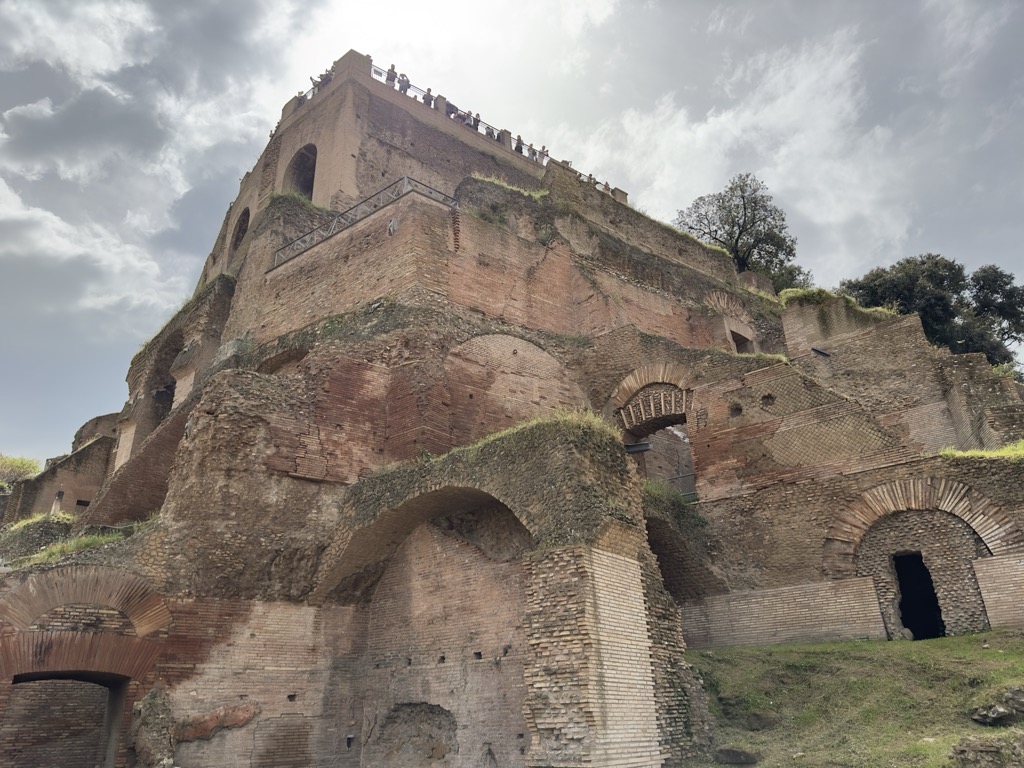
Palatine Hill
Imperial Palace, House of Augustus, House of Livia, Stadium of Domitian and More!
Palatine Hill Imperial Walk – Rome’s First Kingdom
Step onto the ridge where Romulus drew his first boundary and where every emperor later woke to the sunrise. This optimized route traces Rome’s evolution from prehistoric timber huts to the soaring brick arches of the high Empire.
The Archive and the Hidden Chamber
Begin your journey at the Palatine Museum, the hill's central archive where 8th-century BC artifacts and marble imperial portraits provide the "detective’s kit" for the ruins outside. Just steps from the museum’s north face, enter the Aula Isiaca and Loggia Mattei. This vertical time capsule allows you to stand on a 16th-century Renaissance balcony while looking down into a Roman hall painted with vivid Egyptian motifs; a testament to Rome’s ancient fascination with the East.
The Renaissance Canopy
Head North into the Farnese Gardens, one of Europe’s first botanical gardens. These 16th-century terraces were built as a "pleasure pavilion" directly over the massive, buried vaults of the Domus Tiberiana. Walk to the northern balustrade between the twin aviaries for the definitive "emperor’s view," where the Roman Forum spreads out like a toy model below your feet.
The Descent into Antiquity
From the gardens, follow the Ramp of Domitian, a grand, vaulted underground highway designed for the Emperor’s horses and litters. Descend into the cool hush of Santa Maria Antiqua at the base of the hill. Known as the "Sistine Chapel of the Early Middle Ages," its vibrant Byzantine frescoes bridge the gap between the pagan empire and Christian Rome.
The Sacred Village and Imperial Hearth
Return to the summit via the ramp and head West to the Hut of Romulus. Here, simple post-holes in the bedrock mark the city's 8th-century BC birth. Contrast this primitive start with the nearby House of Augustus and House of Livia, where sapphire and cinnabar frescoes remain remarkably vibrant. These homes were physically linked to the Temple of Apollo Palatinus, whose massive marble podium served as the spiritual headquarters of the Augustan regime.
The Throne and the Stadium
Walk into the heart of the central palace: the Domus Flavia and Domus Augustana. Explore the vast throne halls and octagonal fountain courts that served as the Empire's administrative nerve center. Continue South to the Stadium of Domitian, a private, sunken garden arena. As you walk the upper perimeter, imagine the imperial court strolling through the shaded porticos below.
The Grand Finale
Reach the southernmost tip of the hill for the tour’s spectacular conclusion: the Arcate Severiane (Severan Belvedere). Standing atop these massive brick substructures, you are suspended on a man-made extension of the hill designed to awe travelers arriving from the Appian Way. From this height, the Colosseum and the Arch of Constantine are framed in a panorama that captures the sheer scale of the "Eternal City."
Practical Tips
- The Route: A logical 1.8 km loop that minimizes backtracking and ends near the southern exit.
- Access: The House of Augustus, House of Livia, Santa Maria Antiqua, and Aula Isiaca require a Full Experience (SUPER) ticket.
- Navigation: Carry water and wear sturdy shoes; the ancient basalt paths and the long climb from the entrance can be strenuous.
Audio Preview
Introduction to Palatine Hill
Route Overview
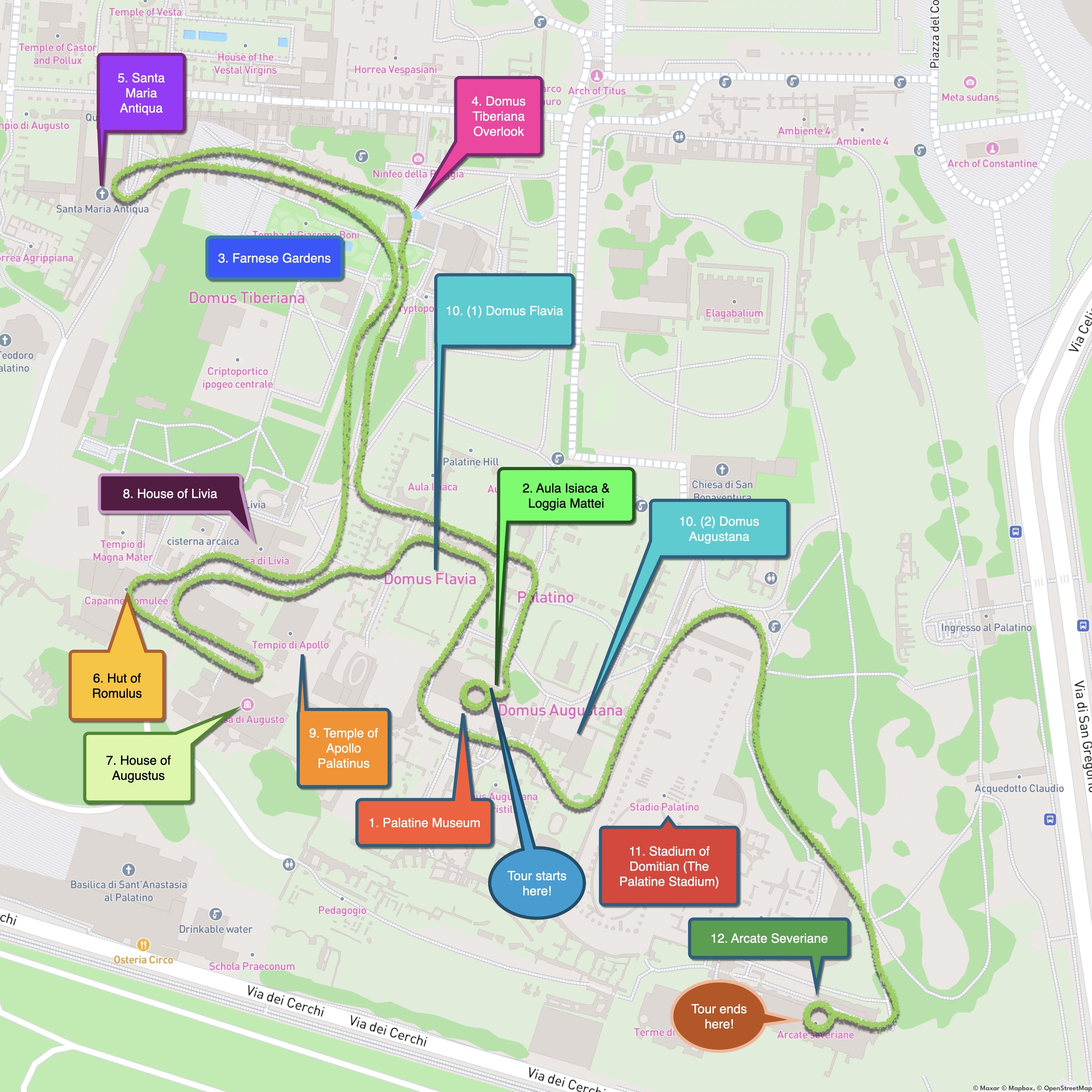
Stops on this Tour (12)
Palatine Museum
Welcome to the Palatine Museum. We begin this chapter of our journey here because this building acts like a detective's kit for the ruins outside. You likely entered through the gate on <lang lang="it">Via di San Gregorio</lang> and followed the long, uphill climb, a walk that traces the very ascent the emperors once made. While the scattered stones outside are grand and silent, the objects inside this museum still speak with the voices of the people who held them. Before we explore the empty palaces under the open sky, we will use these artifacts to rebuild that lost world in our minds.
Aula Isiaca & Loggia Mattei
We have arrived at a door that many visitors walk right past, unaware of the vibrant secrets hidden inside. This entrance leads to a building that works like a vertical time machine. You will enter through the <lang lang="it">Loggia Mattei</lang>, a 16th-century balcony adorned with Renaissance frescoes, and then look down into the <lang lang="la">Aula Isiaca</lang>, a Roman hall buried beneath it. We are about to see two different golden ages of Rome literally stacked on top of each other: the refined Egyptian-style paintings from the dawn of the Empire and the elegant mythology of the Renaissance, separated by fifteen hundred years of history.
Farnese Gardens
Welcome to the Farnese Gardens, or the <lang lang="it">Orti Farnesiani</lang>. You have just climbed the path from the museum, leaving the enclosed galleries for the fresh air of this historic plateau. It might feel like you have jumped straight from the ancient empire to the Renaissance, but the story is more complex. For over a thousand years between those two eras, this hill was never truly empty; it served as a fortress for the powerful <lang lang="it">Frangipane</lang> family, a quiet vineyard for monks, and even a quarry where builders harvested ancient marble for new churches. What you see now, the rose bushes and citrus trees, is the final, elegant layer placed over the bones of the Caesars.
Domus Tiberiana Overlook (Uccelliere Farnesiane)
You are now standing at the edge of the Farnese Gardens, perched on a balcony that separates two very different worlds. Behind you is the perfumed, manicured leisure of the Renaissance, but in front of you is the raw, vertical power of the Roman Empire. You are resting on top of the massive substructures of the <lang lang="la">Domus Tiberiana</lang>, the first true imperial palace to claim this side of the hill. This structure was designed to physically elevate the emperor above his subjects, allowing him to look down into the busy Forum while remaining isolated in luxury. Take a moment to anchor yourself here, with the heart of ancient Rome spread out at your feet.
Santa Maria Antiqua
As you emerge from the Ramp of Domitian, you step from the shadowy corridor of the emperors into the sacred, hushed atmosphere that replaced it. This is <lang lang="it">Santa Maria Antiqua</lang>, a building that physically bridges the gap between the pagan empire and the Christian Middle Ages. You are standing in the structural shell of a monumental imperial vestibule that was consecrated as a church in the 6th century. It is a 'Sistine Chapel of the Early Middle Ages,' where the architecture of the Caesars and the vibrant, Byzantine-style frescoes of the early Church are visibly fused.
Hut of Romulus
You have now reached the most ancient and sacred corner of the Palatine Hill. We have walked through the palaces of emperors who commanded the world, but here we find the place where the command was simply, 'Survive.' You are standing in front of a protective roof that covers a patch of rough, exposed bedrock. At first glance, this might look underwhelming, just a few post-holes and channels cut into the dark tufa stone. But do not let the simplicity fool you. You are looking at the physical birth certificate of Rome, where 8th-century BC shepherds built the first timber-and-thatch huts of what would become the Eternal City.
House of Augustus
You have just walked from the primitive, earth-bound dwellings of Rome's founders to the home of the man who became its first master. Augustus understood the power of symbols; as you enter this house, notice how it balances supreme authority with a deliberate, calculated restraint. He did not build a sprawling palace of gold; instead, he built a sophisticated residence that shared the same sacred ground as Romulus, framing himself not as a tyrant, but as the humble restorer of the ancient Roman way.
House of Livia
Leaving the rooms of Augustus, we step into the intimate and elegantly decorated spaces traditionally attributed to his wife, Livia. While these wings were physically separate, they functioned together as the private heart of the early Empire. Here, the solid brick walls seem to dissolve into 'Second Style' frescoes, masterpieces of perspective that create the illusion of lush gardens and grand porticos. It is a reminder that even in their most private moments, the imperial family lived within a world of carefully crafted, theatrical beauty.
Temple of Apollo Palatinus
We have just walked from the mud and thatch of the Hut of Romulus to a wide, open terrace. The contrast is intentional and stark. We have moved from the place where Rome was born from the earth to the place where it was reborn in marble and propaganda. Augustus didn’t just build a temple here; he built a spiritual headquarters for his new regime, physically linking his own home to the house of a god. You are standing before the ruins of the Temple of <lang lang="la">Apollo Palatinus</lang>, a monument once clad in white <lang lang="it">Carrara</lang> marble and filled with Greek masterpieces, a statement that the power of the Caesars was ordained by the heavens.
Domus Flavia & Augustana
You are exploring the heart of the Palatine: the <lang lang="la">Domus Augustana</lang> and <lang lang="la">Domus Flavia</lang>. To understand this maze of broken brick, think of it as a massive, two-story complex built to balance the emperor's two lives. You are likely standing on the upper terrace of the <lang lang="la">Domus Augustana</lang>, the private residence. Below you, the garden level unfolded in a sunken courtyard, hidden from the prying eyes of the city. To the north, this residential wing merges into the <lang lang="la">Domus Flavia</lang>, a series of grand, public halls where the emperor met with ambassadors and held state banquets.
Stadium of Domitian (The Palatine Stadium)
After the walk across the hill, you have reached the Stadium of Domitian. As you step onto the viewing platform or descend the steps, notice the sudden shift in atmosphere. You are looking into a long, sunken arena designed as a private mirror of the public spectacle, turned inward for the pleasure of the imperial court. While the massive <lang lang="la">Circus Maximus</lang> in the valley below entertained hundreds of thousands of Romans, this secluded space was built to shut the world out, serving as a lush garden, a place for private exercise, or perhaps even a venue for intimate footraces.
Arcate Severiane
You have made it to the final and perhaps most spectacular summit of our journey. As you step onto this terrace, look down: you are suspended in mid-air by the <lang lang="it">Arcate Severiane</lang>, the colossal brick substructures that Emperor Septimius Severus built to extend the hill itself. This is the Palatine’s grandest engineering statement, a man-made plateau designed to ensure that the Emperor’s palace was the first thing a traveler saw when approaching the city from the south. You are standing on a stone 'billboard' built to awe the world.
Start this Journey
Download the Rome Audio Tour Guide Offline app to unlock the full audio guide, offline maps, and GPS navigation for this tour.